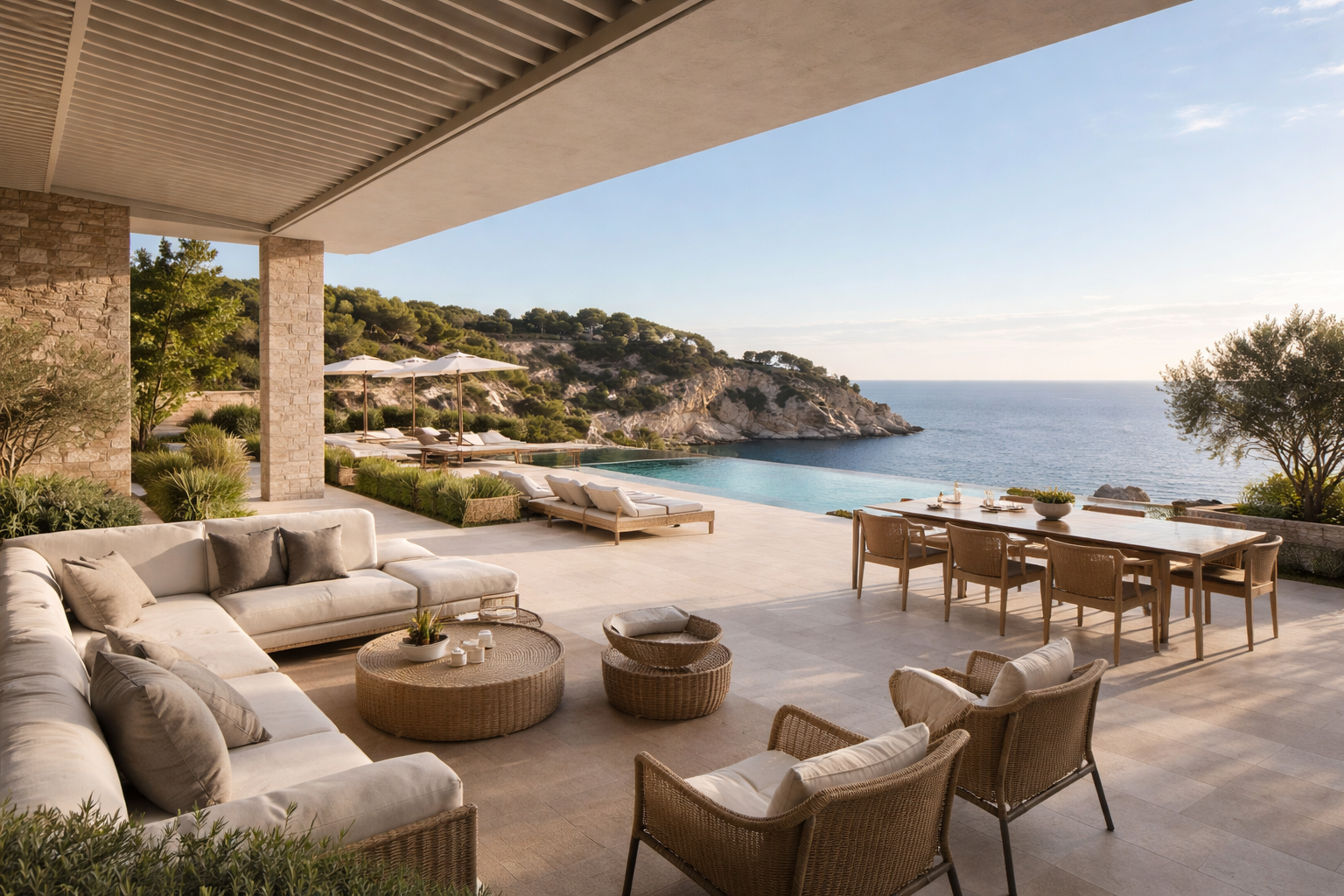
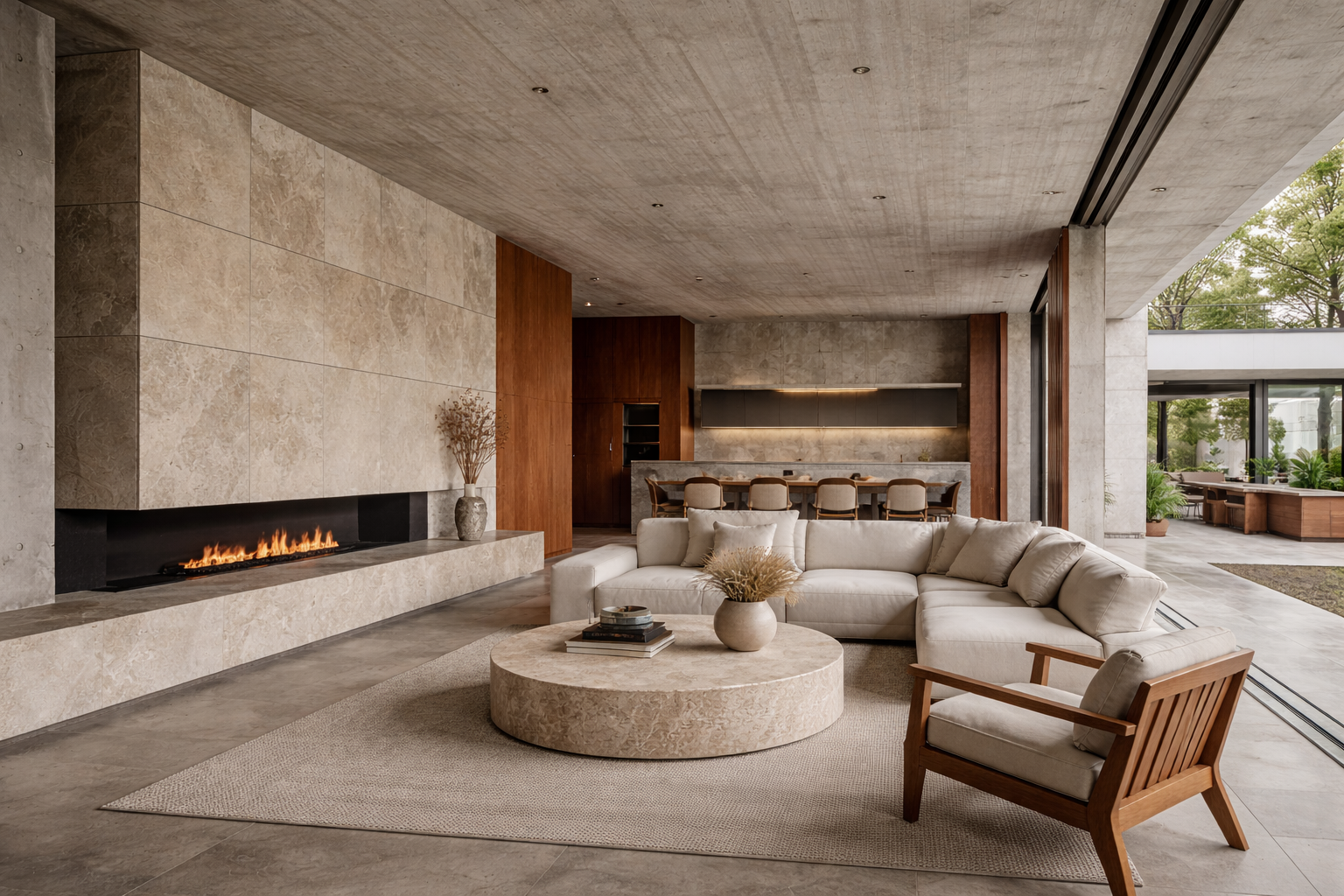
The trend in luxury villa design on the Costa Blanca is clear: the removal of visual barriers. We want the house to flow, the interior to spill out into the exterior, and the rooms to appear larger. The key to achieving this “infinite” effect is the use of continuous flooring.
However, when the time comes to choose the material, the great dilemma arises: Do we opt for artisanal microcement or the technology of large format porcelain? At La Quinta Fachada, we honestly analyse both options to help you decide.
Aesthetics of continuous flooring: The search for the invisible
The goal of continuous flooring is for the pavement not to be the protagonist, but a neutral canvas that unifies the home.
-
Microcement (real continuity): It is the only truly continuous material. There are no joints, neither expansion nor installation joints (if applied correctly). It is an artisanal material, with natural “waters” and imperfections that give it an organic and warm character, highly sought after in the modern Mediterranean style.
-
Large format porcelain (visual continuity): Thanks to current technology, there are slabs of up to 120×120 cm or even 3 metres. Although technically joints exist, by being rectified and using grout of the exact same colour tone, they become almost invisible to the eye, simulating the effect of continuous flooring.
Resistance and durability: The real life test
This is where the differences become notable. When choosing continuous flooring, one must think about daily use.
-
Porcelain: It is practically indestructible. It does not scratch if you drag a chair, it does not stain if a glass of wine falls, and it does not change colour with the sun. It is the ideal option for families with children, pets, or for high-traffic areas (and beach sand) such as the entrances of villas in Javea or Calpe.
-
Microcement: It is more delicate. Although modern sealers have improved greatly, it remains a surface that can suffer scratches or strong impacts (such as dropping a heavy pointed object). It requires more careful maintenance and, over the years, acquires a “lived-in” patina.
Continuous flooring and underfloor heating: Which is more efficient?
If you read our previous article, you will know that underfloor heating is non-negotiable. How do these materials behave?
Both are excellent conductors, but with nuances:
-
Microcement has a thickness of barely 3mm. This allows heat to pass through very quickly; the house warms up sooner.
-
Porcelain has greater thermal mass. It takes a little longer to warm up, but it retains heat for longer, releasing it gradually.
For practical comfort purposes in a permanent residence, both are magnificent allies of radiant continuous flooring.
The architect’s verdict
The choice depends on your lifestyle:
-
Choose microcement if you are looking for an organic, artisanal, and unique aesthetic, and you are willing to treat the floor with some care (as you would with natural wood flooring).
-
Choose large format porcelain if you seek technical perfection, “zero maintenance”, and total peace of mind regarding stains and bumps, whilst maintaining that visual aesthetic of continuous flooring.
Still have doubts? Contact us. At La Quinta Fachada, we will show you physical samples of both materials so you can touch and feel the foundation of your future home.