When someone comes to us wanting to build a villa on the slopes of the Montgó, in Dénia, the first question we ask ourselves has nothing to do with style. It has to do with the mountain. The Montgó isn’t just a scenic backdrop for the plot photos — it’s a real condition that shapes most of the design decisions from the very first sketch, something any architect in Dénia with experience on this hillside takes for granted before drawing a single line.
That already sets it apart from the other areas we usually work in across the Marina Alta. In Las Rotas, for instance, the main factor is the coastline itself: rock, salt air, proximity to the cliffs. On the Montgó the challenge is different, because the land answers to the logic of a protected natural park, and that difference shows up in very concrete ways — plot sizes, the steepness you have to work with, and even the kind of owner who ends up buying there.
Let’s start with the physical side. Plots in this area tend to be considerably larger than what you’ll find elsewhere in Dénia, or in much of Jávea for that matter, and that changes how a project gets approached from day one. It’s not about squeezing every square metre out of a tight urban plot, but about deciding which part of the land to build on and which part to simply leave alone. In exchange, the slope is usually steeper than in areas like La Pedrera or La Marquesa, so from the start you need to work out how the villa is accessed, where the garage goes, and how many levels make sense stepping down the hillside without triggering an excessive amount of earthworks.
That’s where the question that comes up most often enters the picture: the protection of the natural park. It’s worth clearing this up calmly, because it tends to cause more worry than it should. Building near the Montgó doesn’t mean everything is off the table — it means there are clear rules on setbacks, plot coverage and height that need to be on the table before falling in love with a particular plot. An architect in Dénia who knows this area well can look at a plot and tell almost immediately what’s feasible and what simply isn’t, which saves months of back-and-forth for anyone who hasn’t bought the land yet.
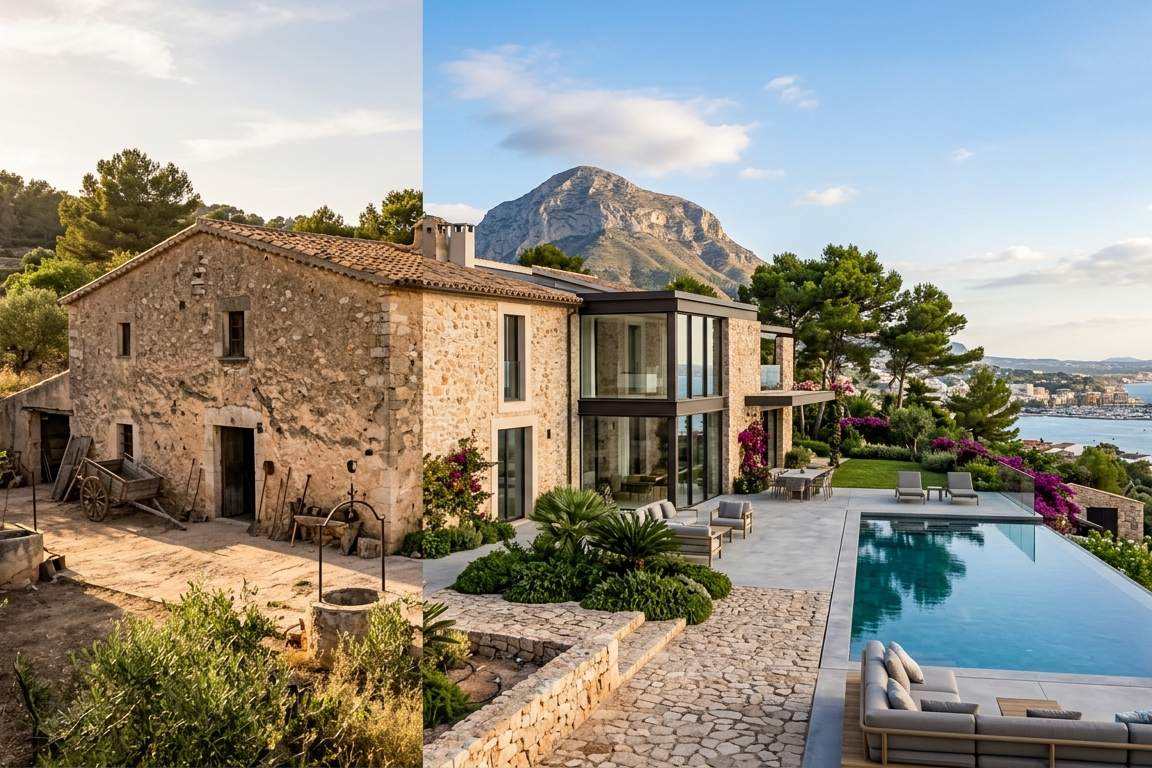
What makes all that groundwork worthwhile is an advantage few areas in the Marina Alta can offer at once: sea views and mountain views from the same plot. In more built-up areas you usually have to choose between privacy and an open view, because wide views tend to mean being exposed to the street or to neighbouring plots. On the Montgó’s slopes, if the orientation and the massing are studied properly, you can have both — a façade that opens onto the Mediterranean while the overall feel of the villa stays far more secluded than in a conventional development.
There’s another factor here that often gets overlooked: the vegetation. The natural park frequently requires keeping much of the existing tree cover in place, and that’s less of a constraint than it sounds, provided it’s factored into the design from early on. A century-old pine in the wrong spot can end up blocking the very view you were after, but that same pine, respected and worked into the layout, can become the feature that gives real character to a porch or a terrace that would otherwise feel generic. It’s the kind of detail you only catch by walking the land before drawing anything, not by looking at a plan from an office.
That also explains the type of owner who tends to end up here. It’s not the buyer chasing a five-minute walk to the beach or a beachside bar. It’s someone who values quiet, the sense of being tucked inside a protected landscape, and a kind of privacy that comes from the topography itself rather than from a tall wall. That profile — usually an international buyer who has already looked at several spots along the Costa Blanca before settling on this one — shapes the project almost as much as the slope does: less exposure toward the entrance, more emphasis on an inner courtyard or the pool as the heart of the house, and a Mediterranean garden meant to blend into the hillside rather than push against it.
There’s one more detail specific to this area that’s easy to miss: vehicle access. Many plots on the Montgó hang off narrow, winding roads that weren’t exactly designed with heavy construction traffic in mind. Before finalising a project it’s worth checking how the concrete truck will get in, where the crane will manoeuvre if one is needed, and whether the final access to the villa will match the one used during construction. These are questions nobody asks on a plot in a standard residential development, and here they can affect both the budget and the build timeline.
In the end, designing on the Montgó has more in common with designing on a mountain plot than a coastal one, even though the sea is perfectly visible from the living room. It’s a different logic from Las Rotas, and quite different again from the more established areas of Dénia or Jávea — and an architect in Dénia who has worked across both settings knows that applying the same approach to each is usually the first mistake on any project on this hillside. Understanding that difference before buying the plot, rather than after, is what separates a project that moves forward smoothly from one that gets stuck at the first planning report.
Frequently asked questions
Can you build freely on the slopes of the Montgó, or are there a lot of restrictions? You can build, but within clear rules on setbacks, plot coverage and height because of the neighbouring protected natural park. It’s not that construction is banned — it’s that those rules need to be understood before buying the plot, not discovered halfway through the project.
Why are plots on the Montgó larger than in other parts of Dénia? Largely because of the character of the area itself — lower building density and a hillside topography have historically led to more generous plot sizes than in areas like La Pedrera or central Dénia.
Can you get sea views and privacy at the same time here? In most cases, yes, which isn’t always true in more built-up areas. With the right orientation and massing on the slope, it’s possible to face the Mediterranean without being exposed to the street or to neighbouring plots.
Do you have to clear the existing trees to build a villa here? Not necessarily — often quite the opposite. The natural park usually requires preserving much of the existing vegetation, and when it’s worked into the design, it can become the feature that gives a terrace or porch its character.
Can access to the plot be a problem during construction? It can be, if it isn’t checked beforehand. Many roads in the area are narrow and steep, so it’s worth confirming how construction machinery will get in before finalising the project, to avoid unexpected costs or delays.