The residential property sector is undergoing its most significant regulatory shift in decades. With the consolidation of Spain’s National Building Renovation Plan (PNRE 2026), the enforcement of the updated Energy Performance Certificate (EPC v3.0), and the binding roadmap set by the EU Energy Performance of Buildings Directive (EPBD), designing or refurbishing a home in Spain is no longer purely an aesthetic exercise: energy performance now directly dictates a property’s long-term market value.
Whether you are planning a bespoke new-build villa or a full-scale refurbishment on the Costa Blanca or in Valencia, these are the technical requirements you need to integrate today before the stricter 2030 thresholds come into force.
1. What Exactly is a Zero-Emission Building (ZEB)?
Until recently, Spain’s Technical Building Code (CTE) required new dwellings to meet Nearly Zero-Energy Building (nZEB) standards. The revised European framework takes the decisive step towards Zero-Emission Buildings (ZEB), which will become mandatory for all new residential properties from 2030 onwards (and from 2028 for public buildings).
A ZEB property must satisfy three simultaneous technical criteria:
- Ultra-low energy demand: A continuous thermal envelope free from thermal bridging, controlled airtightness, and high-performance glazing that drastically minimise the need for active heating and cooling.
- Zero on-site carbon emissions: Complete elimination of boilers or systems reliant on fossil fuels within the plot.
- 100% renewable energy supply: The minimal energy required by the household is met through on-site renewable generation (integrated solar photovoltaics, high-efficiency aerothermal heat pumps, or geothermal systems).
2. Regulatory Timeline 2026 – 2030 for Homeowners and Investors
| Milestone | Regulatory Requirement (Spain / EU) | Impact on New Builds & Refurbishments |
|---|---|---|
| Late 2026 | Conclusion of PNRE 2026 and full implementation of EPC v3.0. | Stricter calculations for thermal bridging, MEP systems, and solar shading in chartered projects. |
| 2027 – 2029 | Full national transposition of the EPBD and rollout of Renovation Passports. | Mortgage lenders and international buyers heavily discount villas rated E, F, or G. |
| 1 January 2030 | Mandatory Zero-Emission Building (ZEB) standard for all residential new builds. | Every new villa must demonstrate zero operational carbon emissions and on-site renewable generation. |
3. How These Rules Affect New-Build Villas on the Costa Blanca
In prime coastal locations such as Javea, Altea, and Moraira—where Northern European and British buyers seek turnkey homes suited for year-round living—building to bare minimum legal standards today means creating a property that will be technically outdated within four years.
Across our architectural projects in Javea and the wider Costa Blanca, we future-proof every villa ahead of 2030 by pairing contemporary Mediterranean design with rigorous building physics:
Passive Solar Design Tailored to the Mediterranean Climate
A poorly oriented west-facing panoramic window can turn a sea-view living room into a greenhouse in July. We calculate concrete overhangs, adjustable timber louvres, and low-emissivity solar-control glazing down to the millimetre—blocking harsh summer radiation whilst capturing free passive warmth during the winter months.
Seamless Integration of High-Efficiency Systems
We replace conventional HVAC setups with aerothermal heat pumps paired with underfloor heating and cooling, mechanical ventilation with heat recovery (MVHR) that filters incoming air and regulates indoor humidity without opening windows, and flush-mounted solar panels that preserve the villa’s clean architectural lines.
4. Comprehensive Refurbishments: Protecting Existing Properties from Depreciation
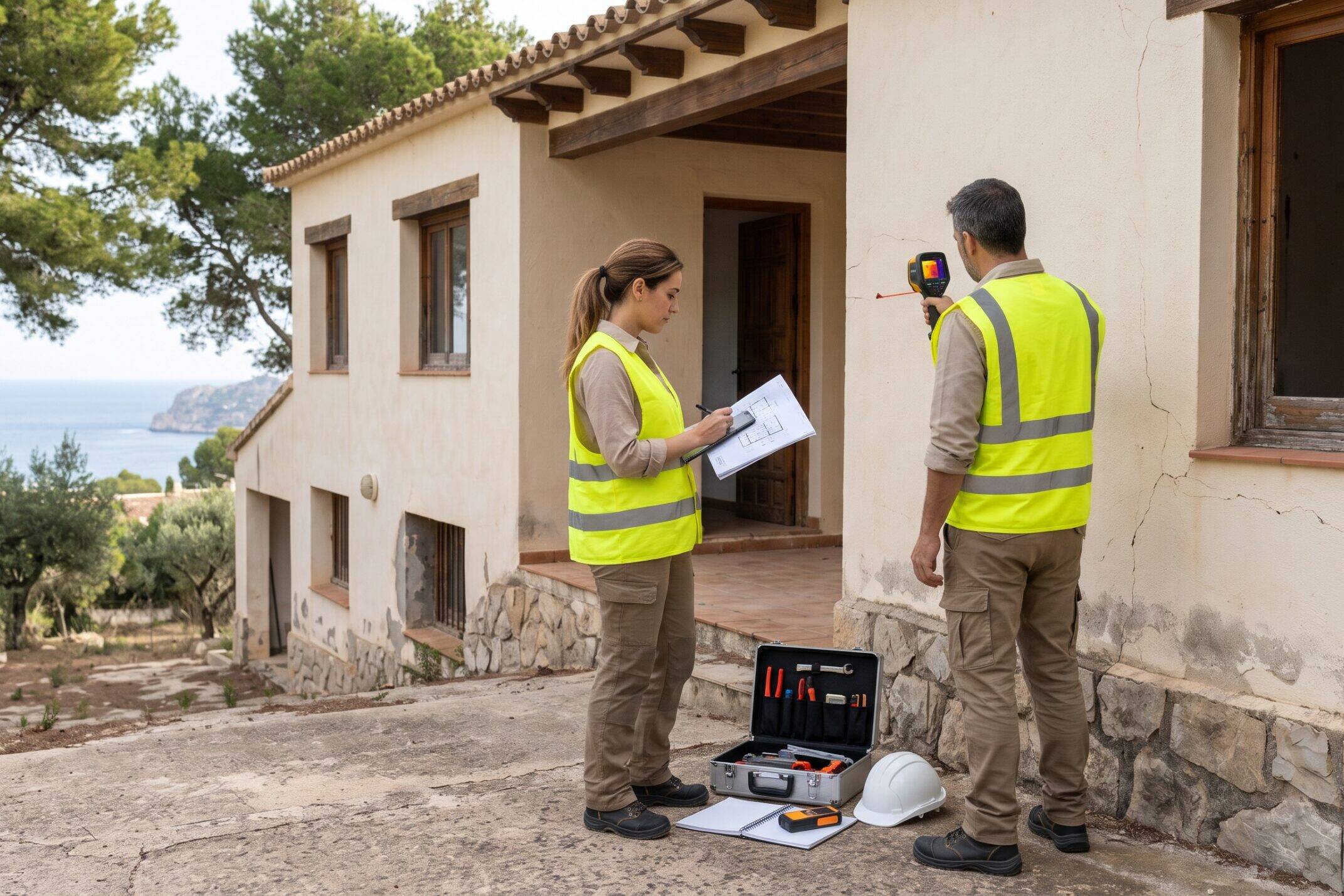
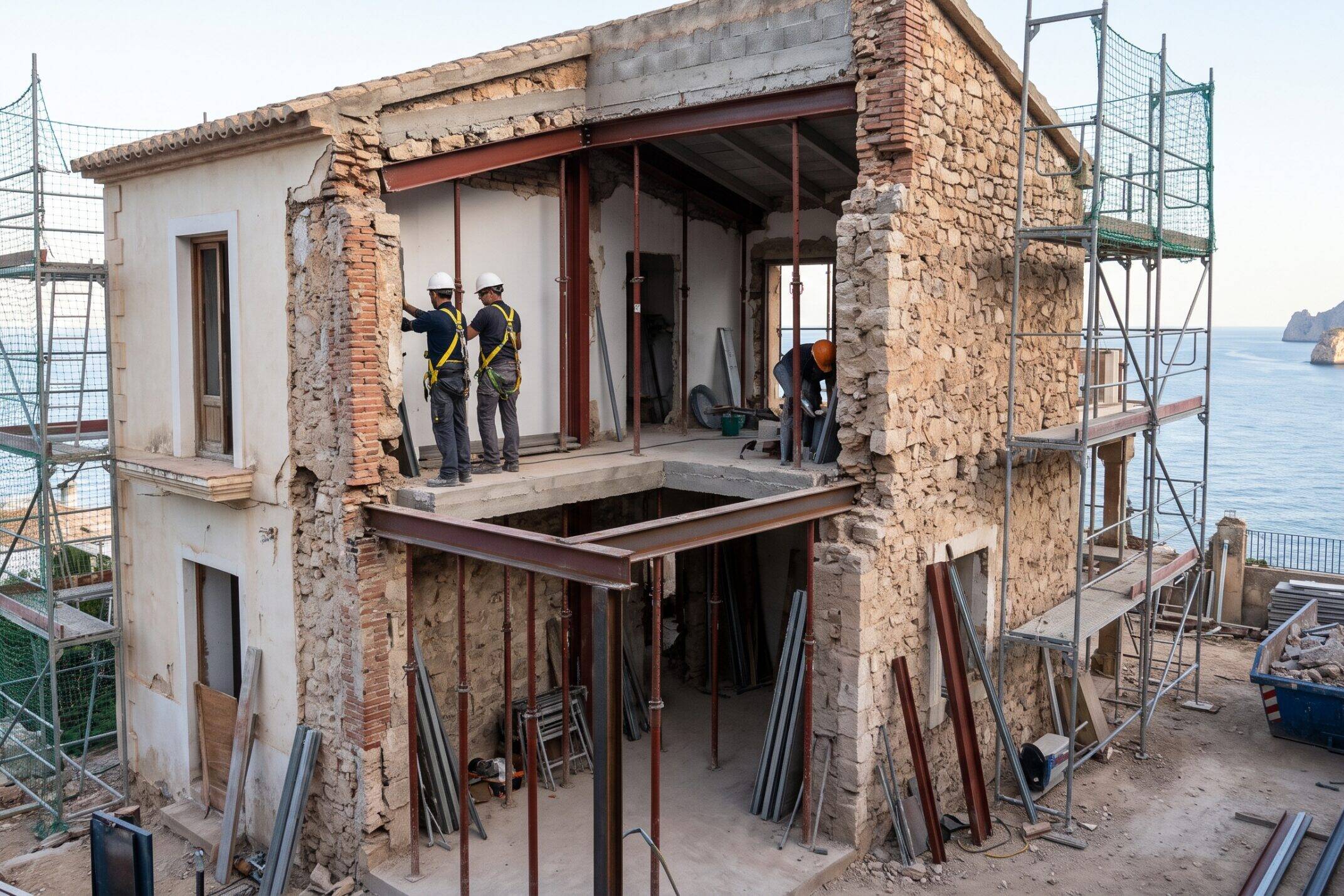
Both the European Commission and Spain’s Ministry for the Ecological Transition (MITECO) are focusing heavily on existing housing stock, which accounts for over a third of total carbon emissions. When undertaking a major refurbishment of a 1980s coastal villa or a period apartment in Valencia city centre, upgrading thermal performance is no longer optional.
Installing external wall insulation systems (ETICS/SATE), sealing air leaks around shutter boxes, and modernising heating and cooling plant allows an older F- or G-rated property to achieve an A or B energy rating. Beyond cutting annual electricity bills by up to 75%, this safeguards resale liquidity against upcoming EU restrictions on selling or letting energy-inefficient homes. Explore how we manage these upgrades at our construction and refurbishment studio in Javea and our architecture practice in Valencia.
Conclusion: Designing Today to 2030 Standards
Integrating Zero-Emission Building principles into your project from the very first sketch does not inflate overall construction costs; on the contrary, it prevents expensive retrofits later on and guarantees superior thermal and acoustic comfort from day one.
At La Quinta Fachada, we design bespoke new-build villas and full refurbishments grounded in bioclimatic architecture and Passivhaus principles. If you are planning to build or renovate a home in Valencia or on the Costa Blanca, contact our technical team for a tailored energy and financial feasibility assessment.